AIF User Spotlight
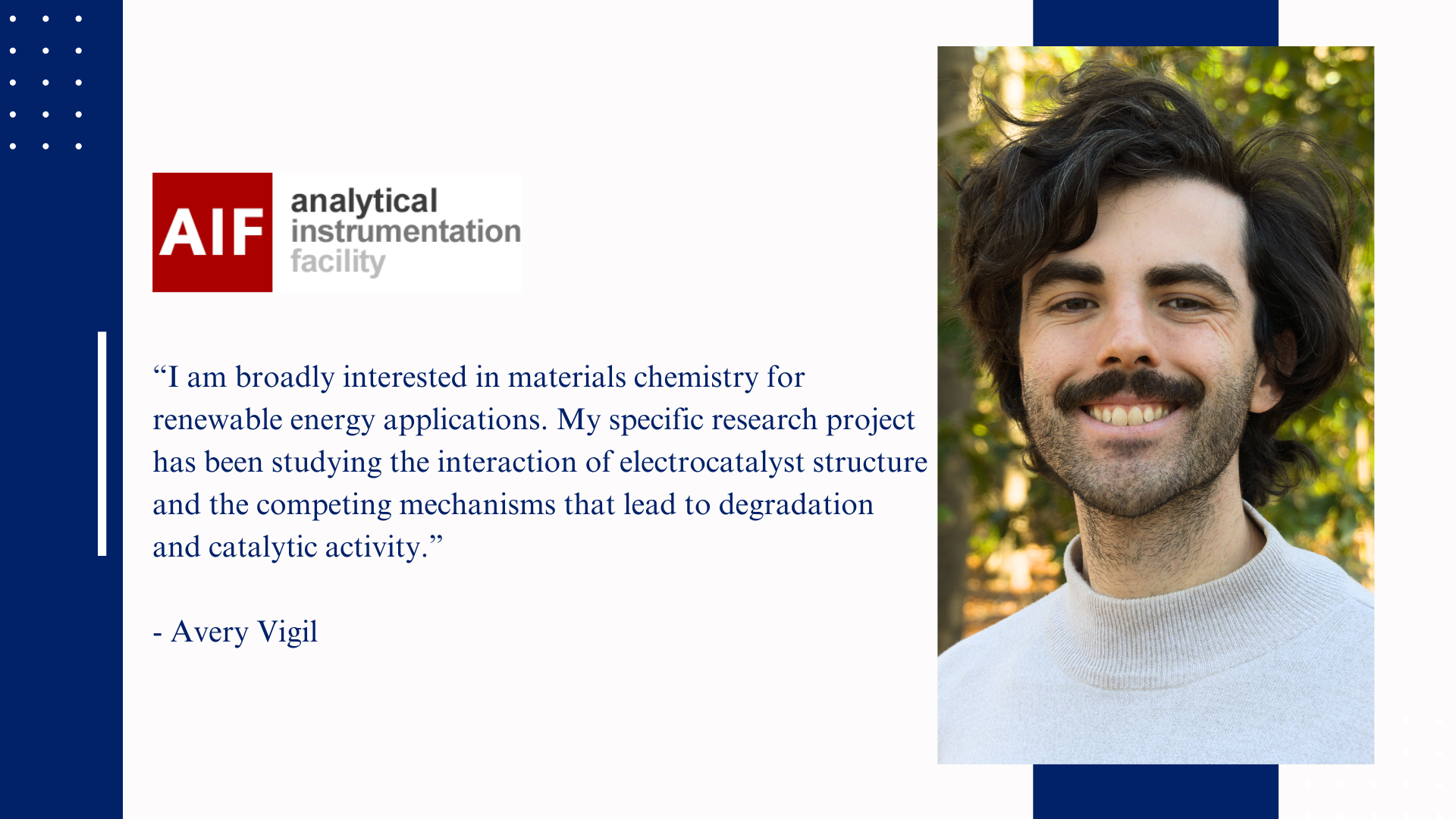
Avery is a 3rd year graduate student in the Chemistry department at Duke University, in Prof. Ivan Moreno-Hernandez’s group. They’re deeply motivated by climate change and the desire to know more about the world around them—chemistry enables them to look around and understand the world on an atomic level, to see the shapes of the molecules that make up their environment, while also giving them the toolkit to attempt to make an impact in renewable- and clean-energy technologies. Avery hasn’t decided what they want to do after graduate school, but they know they want to live somewhere bike-friendly! Outside of research, Avery enjoys making and playing board games with friends and riding their bike.
What instruments are you using for your research?
I primarily use the Thermo-Fisher Titan microscope to characterize electrocatalyst nanomaterials via scanning transmission electron microscopy (STEM) in both dry conditions and in-situ. I love that the instrument gives me the capability to observe electrocatalysts on the individual atom level.

How is your research impacting the community?
I am broadly interested in materials chemistry for renewable energy applications. My specific research project has been studying the interaction of electrocatalyst structure and the competing mechanisms that lead to degradation and catalytic activity. This research has taken me through instrumental methods development, catalyst design and discovery, and fundamental mechanistic studies using electrochemical methods. I have chosen to focus on anodic reactions, such as the oxygen evolution reaction, due to their industrial necessity and electrochemical complexity. I utilize advanced in-situ TEM methodologies to observe the structural evolution of electrocatalytic materials in dynamic environments, and the Titan microscope is perfect for my applications.

The development of next-generation electrocatalysts with reduced cost, improved activity, and improved stability will enable the integration of renewable energy platforms, such as wind and solar energy, with the generation of chemical fuels such as hydrogen and hydrocarbons. In my view, this is a necessary coupling to achieve the goal of an energy ecosystem that is primarily built on renewable energy, as it will allow for energy to be stored long-term in the form of chemical bonds. This problem has been studied for over a century, but I am hopeful that the research that I perform in grad school will have a lasting impact on the field of electrocatalysis.
One of the pieces of advice for electron microscopy that Chris Winkler gave me when I was first training on the Titan has really stuck with me: “Perfect is the enemy of good.” The electron beam can always be rounder, but knowing when it is round enough to get atomic resolution is a critical skill!
– Avery Vigil
Best thing about AIF in 5 words or less?
Amazingly helpful staff!
Is there a staff member at AIF that has helped you?
Chris Winkler has been an amazing help for me with STEM data collection. The technique is so complex, with so many knobs to turn; Chris has always been available to help if I can’t figure out which knob is right. He assisted me directly with collecting data for my first paper, and I’m so grateful for that.